Sunday, August 9, 2015

The Basilica Cisterns

Now I'm finally getting around to starting to write about my trip to Istanbul. Istanbul has several great historical buildings that have been turned into museums, like Topkapi palace and Aya Sofya, but one of my favorites was the basilica cisterns, which is also listed here in Travel + Leisure's 25 Coolest Underground Wonders. It certainly didn't take as long to walk around in the cisterns as it did in Topkapi palace, which was huge, but it's dark and creepy which gives it a unique ambience. There is now a walkway so that visitors can walk around it, and many of the columns are lit which give the cisterns limited visibility. There are also carp in the water, which you can faintly see, which adds just a little bit more to the spectral quality of the place.

The lights on the columns reflect into the water.
The cistern is over 100,000 square feet and contains 12 rows of 28 columns. It was built in the 6th century during the reign of Emperor Justinian I, and provided water to the palace in Constantinople back then. Even in more recent times it provided water to Topkapi palace after the Ottomans built it in the 15th century. It is said the the construction of the cistern took 7,000 slaves. One of the columns inside is different than the others and is called a Hen's Eye column - the designs on it in tear shapes are said to honor the slaves who died while building it.

Hen's Eye column
There are two more unique columns in the cistern, which are similar to the others except that at the base of each is a Medusa head. One is sideways, and one is upside down. It possible that the sideways one was turned that way so that it would fit the size of the column, but the upside down one is the same width whether upside down or right side up, so it must have been placed like that on purpose. One possibility is that they turned it upside down in order to negate the effects of the gorgon's gaze. The Medusa heads were probably originally from a Roman temple or other structure, but no one knows where they actually came from.

Sideways Medusa head at the base of a column.
Though the visit doesn't take long, I loved the slightly eerie atmosphere that was unlike any of the other attractions you'll find in Istanbul. I've since read that there are supposedly several hundred ancient cisterns lying beneath Istanbul, which is fun to think about.


Saturday, August 8, 2015

Pamukkale

The day after I went to Ephesus, I took a day trip to Pamukkale, which is a few hours away from Kusadasi so it really took the whole day. Pamukkale means "cotton castle" and is named for the travertines. Because there are so many minerals in the water some people say it has healing properties and actually the Greek city Hierapolis, which was built at the top, was originally a hospital. The carbonate in the water give the terraces its white color and get deposited as limestone.

Limestone terraces at Pamukkale
The tour dropped us off at the top and we got to look around for two hours. The first thing I did was to go "swim" in the travertines - really they're not deep enough to swim, but you can sit/lie down and relax. It's very refreshing. At the bottom of the pools and a bit around the pools the calcium carbonate deposits turn into white mud which is fun to walk in. There's also a hot springs there, but it's closed off and you have to pay to get in - the price didn't seem worth it at the time when the pools were free.

The pools were relaxing and
also fun to walk around in.
Hierapolis is also on the top of the hill - it is almost all in ruins but in one spot there was an archway with Greek letter carved across the top. While I never studied Greek, as a scientist I've learned some of the Greek letters so I could make out "...MNASIO" which was the remnants of "GYMNASION" or the gymnasium (and baths). There's also an amphitheater in the ruins - its not as large at the one at Ephesus, but the one at Ephesus has been largely reconstructed, and the one here was 90% original.
The amphitheater at Hierapolis is in the background.
The weather was probably just as scorching as the previous day had been, but because I got to dip in the water it felt much milder. I was glad I had gotten to see some of the natural landmarks of Turkey rather than just historical buildings - human history is fascinating but I like having a bit of both. Cappadocia didn't make it on my itinerary this time, though, unfortunately - maybe someday.

Monday, August 3, 2015

The Basilica of St. John

Ephesus is also famous in Christianity for being one of the seven churches of Asia as mentioned in the book of Revelation, as well as for being the place where John spent time living. I was raised Protestant, and every Sunday in Sunday school I used to learn about things in the Bible, knowing it all happened in the Middle East on the Mediterranean, so it was neat to be able to see an actual place where some of the Bible was supposedly written nearly 2000 years ago when the major language of the region was Greek.

Before going to the Basilica and the citadel surrounding it, I visited one of the mosques nearby, known as the Isa Bey Mosque. 

Isa Bey Mosque

Isa Bey Mosque was built in the 14th century. The courtyard is still nicely landscaped. There were two minarets originally - one totally collapsed, and one partially remains.

The storks of Selcuk taking over more ruins
Next I walked up to the Basilica of St. John, commissioned by Justinian I in the 6th century. It is located on the hill where John the Apostle was said to have written the gospel of John and died, according to Christian tradition. In reality it is unlikely that the Gospel of John was actually written by an individual named John, but John is also credited with writing a few other books of the New Testament, including the book of Revelation, which he wrote while he was exiled to the Isle of Patmos. Some Christians take Revelation to be literal and about how the world is going to end, but some Biblical scholars say that John likely wrote it about Emperor Nero and concurrent events.

Ruins of the Basilica of St. John

A turtle in the ruins tries to hide behind a
fallen column to get away from the tourists.
Next to the ruins of the Basilica is the Ayasoluk citadel, originally a Byzantine castle, later rebuilt and added to by the Ottoman Turks. What's left of the citadel contains several cisterns, a byzantine church, and a mosque. I had read that recently the citadel had been closed to the public, but now it is open and you are free to walk around inside.

The Byzantine church, which they say is where St. John spent his time while alive.
I didn't end up getting a good picture of the citadel walls.
It was neat to see a little Christian history while in Turkey - the Aya Sofya is another great example, which I may write about later on. In both cases though you end up with a juxtaposition of Ottoman muslim history on top of Byzantine christian history, which reminds you how drastically a single place can change over time.

Sunday, August 2, 2015

Ephesus, Turkey

A week and a half ago I just got back from my trip to Italy and Turkey - wonderful trip but it also feels good to be back. I may put up some more posts about the trip in the coming days/weeks.

As someone who is not very well versed in world history, one of the really interesting things about Turkey for me was how much history it spans, both in terms of years and number of empires. The southeastern part of Turkey has the Tigris and the Euphrates running through it, and was once part of Mesopotamia known as the cradle of civilization and the part of the world where agriculture was born more than 10,000 years ago. Parts of Turkey later became part of the Greek Empire and then the Roman Empire. The ancient Greek city of Byzantium was renamed by the Roman emperor Constantine I to Constantinople and played an important part in the history of the Christian religion. Constantinople remained Christian for about one thousand years until it fell to the Ottoman Turks and became the capital of the muslim Ottoman Empire as Istanbul. The Ottoman Empire then collapsed and become Turkey after World War I.

One of the highlights of the trip was the ruined city of Ephesus, an ancient Greek city built in the 10th century B.C. What's left of Ephesus (now known as Efes in Turkish) is on a hilltop outside the town of Selçuk near the Aegean coast. Turkey is very hot in July, and the sun beating down at this site was intensified by all of the marble that it could reflect off of. I ended up getting burnt even though I'd put on sunscreen that morning.

One some of the columns and structures you can
still make out inscriptions in Ancient Greek.

Most of the city has now crumbled to ruin, but there are a few places of interest that are still standing or have been reconstructed. One of these is the Library of Celsus, which was destroyed by earthquakes, but whose facade was re-erected in the 1970s.

This view looking up at the entrance of the Library of Celsus
shows some of the intricate stonework.
The Library of Celsus was a Roman building that was completed in 135 AD to honor Tiberius Julius Celsus Polemaeanus, the Roman senator. It housed 12,000 scrolls and there was a mausoleum for Celsus underneath. The front of the facade also contains statues with Greek labels underneath - I could recognize enough greek letters to make out "EPISTEME", the personification of knowledge.

Another of the major sites at Ephesus was the amphitheater. Though much of it has been reconstructed and may not be original, this amphitheater is the largest in Anatolia. It was originally built in the 3rd century B.C. during the Hellenistic Period, but then enlarged during the Roman period.

Amphitheaters like this one were used for events like plays as well as gladiator fights.

Of course one of the things that set Ancient Rome apart from other civilizations were the aqueducts and the plumbing, so no Roman city would be complete without its public bathrooms -

Public toilets in Ephesus


Away from the rest of the ruins of Ephesus, closer to the outskirts of Selçuk, is the ruins of the Temple of Artemis, which was one of the seven wonders of the ancient world. It was built in the Bronze Age and was destroyed and rebuilt three times before its final destruction in 401. Almost nothing is left of it now, and when I visited the area seemed to be a little flooded and now looks marshy.

The Temple of Artemis: once one of the seven wonders of the ancient world,
now home to storks. as well as geese and ducks.

Those who study biblical history also know Ephesus as one of the seven churches of Asia and the place where John was said to have written his gospel - I did visit the basilica of St. John as well but that will probably be saved for another post.

Sunday, April 26, 2015

Lemon drinks

Springtime in the bay area means lots of beautiful weather. My neighborhood gets a fair bit of sun and the heavy drooping branches of our backyard lemon tree made me  want to harvest some to use for refreshments.

Lemon tree at right. In the foreground, an extremely tall dandelion.

I picked ten very yellow and very fat lemons and washed them inside. I peeled them with a vegetable peeler and poured vodka over the peels in order to make this limoncello recipe (note: I don't bother to trim the pith, it turns out just fine). The vodka and peels need to steep for 4 days, so I let that pitcher sit and now I had 10 peeled lemons left over so decided to look up some recipes that require lemon juice.

I didn't really feel like major baking so at first I was mostly looking at recipes for things like lemon vinagrette, but then a ginger lemonade recipe caught my eye. I compared a bunch of recipes and ended up coming up with the one below. After juicing all ten lemons I had 2 2/3 cups of lemon juice, so I scaled up the recipe which is written out for 1 cup of lemon juice.

Ingredients:
2 cups water
1 cup honey
2 tbsp minced fresh ginger
several mint leaves
1 cup fresh-squeezed lemon juice
2 cups club soda

Directions:
Bring honey, water, ginger and mint leaves to a boil, then remove from heat and cover for 10 minutes. Strain the ginger and mint out of the liquid, and then add the lemon juice and club soda. Refrigerate.

I'll also note that it tasted a little heavy on the honey, and light on the ginger, so at the end I threw some more sliced ginger and mint leaves into the container in the fridge which will hopefully add a little more flavor over time. 3/4 cup honey instead of 1 cup might not be a bad idea as well. But all in all, it was a pretty easy recipe and tastes very refreshing on a sunny afternoon!
Athens, GA represent!

Friday, January 2, 2015

New Years Resolutions

It's common to think about resolutions when the New Year begins so I thought I'd throw mine on here.

1. Eat less meat

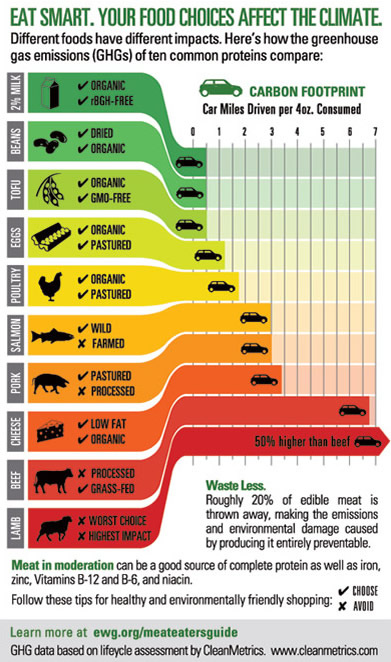
I've been thinking about this more mainly because of the environmental effects of raising livestock. Raising cattle typically requires lots of grain to feed them, and growing all that grain requires lots of water - I heard someone say recently that the amount of water required to produce one beef patty is the amount of water a human will drink in 4.5 years. Not to mention that cattle and other livestock produce a lot of greenhouse gases, which is also bad for the environment. I saw a really neat infographic about it awhile ago, but I can no longer find it. Here's another one:


I'm perfectly happy to eat GMOs so I don't care about that part of it, but it does reflect the carbon footprint that different types of meat have.

Now I don't think I really have the motivation to become fully vegetarian, but I do want to strive for a few things:
1) make vegetarian sandwiches instead of with cold cuts, and pick a good vegetarian option at restaurants instead of a meat option
2) when I do eat meat, choose to eat fish or pork more than beef or mutton
3) opt for game when possible, or wild fish

And then it would probably be a good idea to eat more of things like nuts and peanut butter to get more protein. Of course, even if I stop eating beef entirely, I do consume lots of dairy: cheese, cream, milk, yogurt. I eat LOTS of cheese. And dairy is also produced by cows. But dairy cows are usually different from beef cows, and a cow used for milk can make it for a long time, as opposed to a beef cow being butchered once and producing a finite quantity of meat.

2. Drink less sugar

By now, everyone knows that sugar is bad for you. Places like Whole Foods prides itself on not carrying food that contains high fructose corn syrup, but what the public doesn't seem to realize is that sucrose (sugar, table sugar, cane sugar, natural raw cane sugar, or whatever they want to call it) is pretty much just as bad for you. So if you go to drink a Mexican coke, don't fool yourself into thinking its any better health-wise.

So here's how I want to accomplish this one:
1) Stop drinking soda (by itself at least, i'll probably still allow myself cocktails with soda in them, or the occasional indie root beer)
2) Drink less cranberry juice - I drink a LOT of cranberry juice. It has lots of vitamins, but also lots of sugar. I'll try to drink water instead, or flavor the water if I crave the sweetness too much with an alternative.
3) Cut back on Starbucks - I've started going to Starbucks almost every morning. This is totally unnecessary, and should also help my wallet.

3. Pack lunches for work

This is pretty simple - I go out to lunch almost every day, and probably end up spending a lot of extra money because of it. This mainly happens because I'm lazy and never feel like packing lunch. Or, I make a small sandwich to bring to work, but get hungry again after eating it. I'm going to try to force myself to bring a full lunch almost every day and hopefully this will help me save money.

4. Create (and finish!) a solo choreography

I've been taking belly dance classes on and off for 3-4 years, but I still have never finished creating my own choreography. I'm not particularly creative naturally, and trying to make choreographies is something that I have struggled with when I've tried. But it is something that I want to accomplish and I feel is my next step in my development as a dancer. After all, ideally dance is a form of self-expression.

Those are the big ones - I have high hopes for 2015 and am hoping this summer to have a chance to travel to the Mediterranean and the middle east! That would be my first time outside of North America or Europe! Happy New Year.

Thursday, October 9, 2014

Arrival in Oslo

My Scandinavian trip started today! (Yesterday?) My flight left Oakland around 7 pm and took about 9.5 hours. I had paid extra for a window seat on the left side, since I wanted a chance to see the Northern Lights if they were going to be active, but no luck. Apparently Norwegian Airlines dims the windows during night flights so I didn't get to see stars or anything either. Disappointing. I only managed to sleep very little, and finished reading Shadow over Innsmouth - that afternoon I had found a complete collection of H.P. Lovecraft's works for Kindle on Amazon for $0.99. YES PLEASE.

When we landed, I started to feel a little off, perhaps due to lack of sleep or for not having eaten or drunk very much. I made my way out of the airport to the express train to get to Oslo Central Station, but after I boarded the train I started to feel worse. And some guy ended up sitting next to me, which made me feel even more desperate to not get sick. As we neared Central Station the familiar waves of sweat and dizziness started to wash over me so I lowered my head down and desperately willed myself to not get sick. Then I did nearly vomit but just barely managed to keep it down. But after that moment I started to feel better. When the train stopped, no one in my section moved so I almost missed it because I thought perhaps we weren't supposed to get off yet, but then I ended up getting off just before the doors closed. Then I walked to the hostel.

Here are a few first impressions about Norway:

-  I thought Norway in October would be cold, and the average temperatures that I looked up said it should be in the 40s. I'm someone who gets cold easily, so I had bought a big ski jacket to help keep me warm, and I seem to remember that when it gets cold in SF I really feel it and I wear a peacoat and sometimes even scarf and gloves. But it isn't cold at all here! I've been wearing my octopus v-neck tshirt, with a light fleece jacket on top. Now I have to lug this huge coat around while I'm traveling. But better safe than sorry, I suppose.

- Fashion seems to be a little different here. So far I haven't seen a single woman wearing tall boots.

- Lots of good looking men. This was expected.

- Haven't seen any American fast food chains, but I have passed several 7-11s - weird.

When I got to the hostel, I took a nap because I was short on sleep, but in the evening I got out and walked around the city a little bit. I would have liked to go out for a drink, but I don't feel comfortable going to bars by myself and the one girl I saw in my hostel room didn't seem keen on going out. So I think tonight I'll probably chill out here, perhaps read some more or check out MIT's OpenCourseWare for their intro cs course which I've been meaning to do for a long time. I did look a little bit around meetup.com and couchsurfing.org to see if there were events I could join with other travelers, and I think I'll try to make one in Copenhagen next week.

Tomorrow I'll aim to get up early for breakfast and then head to the Viking ship museum. I will then have to fly out of Rygge to Edinburgh, to visit my friends in Glasgow, but the flight isn't until around 7 pm so I have some time to spend in the city. I've been thinking of making this trip a Viking-themed one and hitting up all the Viking museums I can - the Oseberg ship is in Oslo, there's another museum outside of Copenhagen in Roskilde, and there's a third in Lofoten Islands. The Lofoten one is actually closed during the day while I'm there, unfortunately, but they have some events at night it seems so I'll try to manage that. But either way if I manage to do the Oslo museum tomorrow, then when I come back to Oslo next week I'll be free to do other sightseeing.

Excavation of Oseberg ship in 1904. From
http://commons.wikimedia.org/wiki/File:Excavation_Oseberg_ship_1.jpg

Unfortunately no cool pictures today, really - hopefully there will be some soon!